












People search "southwestern" and "western" blankets expecting different things, even though they often mean the same rack at a store. In our southwestern blankets collection, the distinction is real: this is the pattern-forward side of the desert aesthetic, stepped diamonds, zigzags, and geometric repeats, versus the color-led western look built around a single big motif.
Southwestern: pattern does the talking
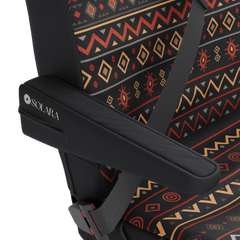
Southwestern design leans on repeating geometry, the stepped-diamond motifs you'd recognize from Navajo-inspired weaving traditions (without us using that name for our product, since ours isn't from that tradition). Our Indigo and Taos prints carry this structure, dense pattern work across the whole panel rather than a few bold stripes. It reads more intricate up close and busier from a distance, which is exactly what some rooms need over a plain stripe.
Western: color and stripe do the talking
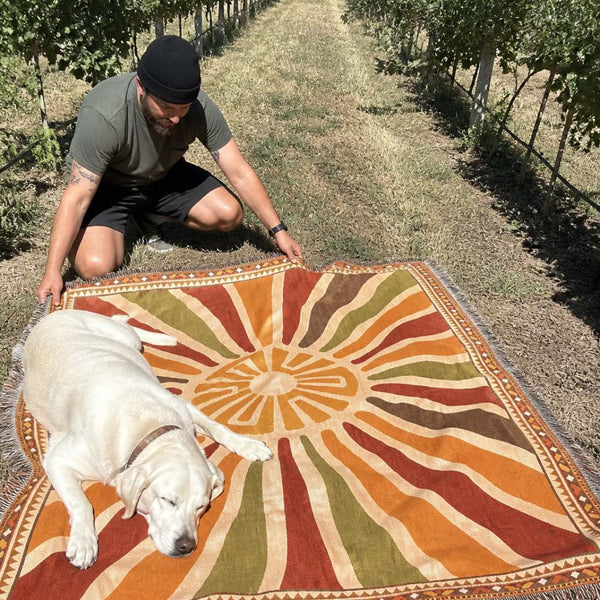
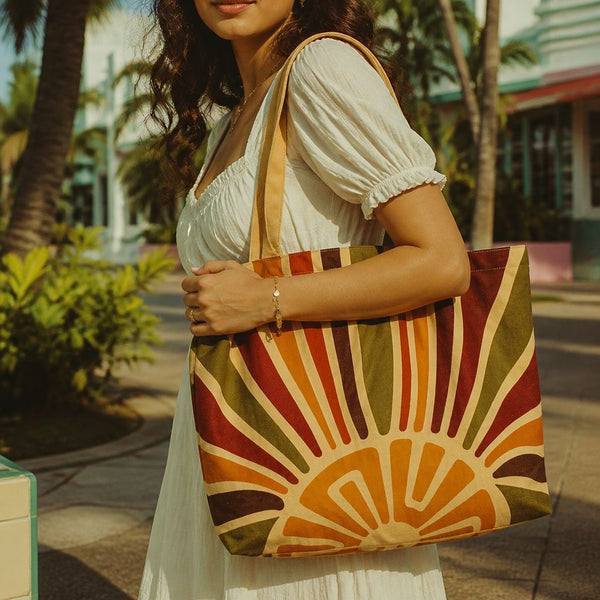
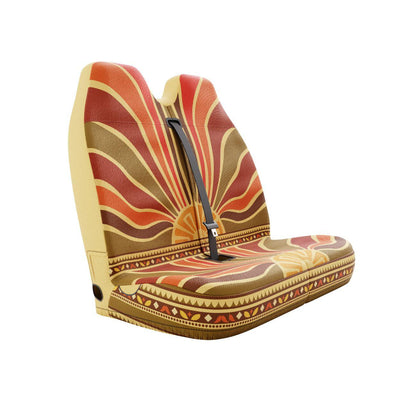
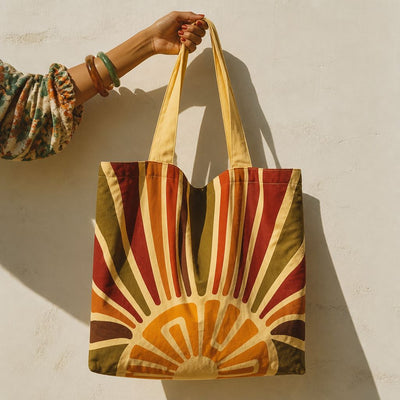
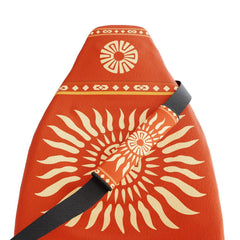
The western side of our line, which we cover separately in the western blankets guide, is built around a single big motif instead: Horizon's rayed sun, Palmyra's palm fountain, Yucca's medallion, in warm rust, ochre, and cream. Less pattern density, more color. If a room already has a lot going on, patterned wallpaper, a busy rug underneath, a single-motif western piece won't fight with it the way a dense southwestern repeat might.
Side-by-side comparison
- Pattern density: southwestern is high (repeating diamonds), western is lower (one central motif)
- Best paired with: southwestern suits a minimal, neutral room that can absorb a busy focal piece; western suits a room that wants color without more visual noise
- Wall use: southwestern prints read better as art from a distance because the repeat pattern holds up at scale
- Couch use: a western piece still reads when folded over an arm, because its warm palette carries the look even when the central motif is hidden in the drape
What they share
Same jacquard weave, same construction, same size: 130 × 180 cm at about 1 kg. Neither is waterproof, so treat both as a styling layer rather than an outdoor textile.
Which one is more "authentic" to the region?
Neither is marketed as authentic Native American weaving, and we don't use tribal names for these prints. They're jacquard-woven interpretations of a broader desert design language, made for home styling, not cultural craft pieces.
Can I use them together in the same room?
Yes, and it often works better than picking one. Use a southwestern print as the wall or floor anchor and a western print as the smaller accent, like a throw on a chair, so the patterns don't compete at the same visual weight.
If you're still deciding, go southwestern for a piece that needs to carry a wall or a plain room on its own, and western for a piece that needs to add warmth without adding more pattern. Browse the southwestern collection and hold a print up against your space before committing, since photos read differently than a blanket actually draped over your furniture.


