

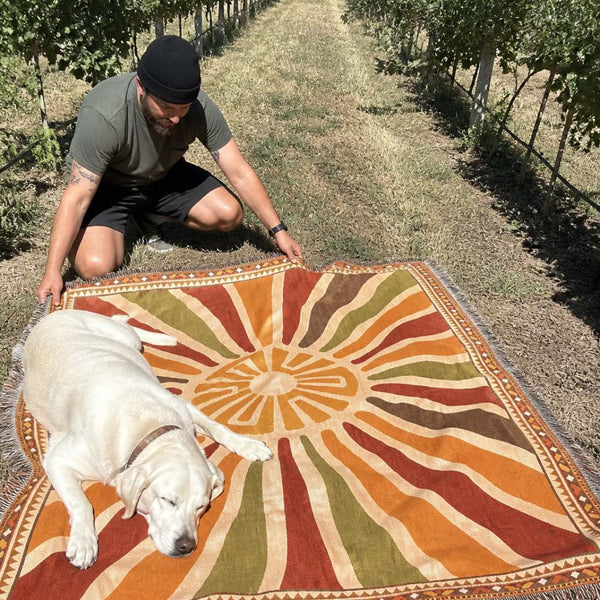











A serape is, historically, a garment before it's a home textile: a long woven cloth worn over the shoulders like a poncho, tracing back to weaving towns in central Mexico like Saltillo. Solara's serape blankets borrow from that same Southwestern textile tradition, woven as jacquard throw rugs sized for a couch, a beach, or a car trunk instead of a shoulder.
Where the Stripe Pattern Actually Comes From
The classic Saltillo serape developed out of a mix of Indigenous weaving techniques and Spanish colonial textile influence, originally dyed with natural pigments and woven on a backstrap or treadle loom by hand. The signature look (tight horizontal stripes in contrasting colors, sometimes building to a diamond medallion at the center) took generations of weavers to standardize into what most people picture today when they hear "serape." It was worn, not draped over furniture, which is a detail most retail listings skip entirely.
Hand-Loomed Versus Jacquard: What Actually Changes
A hand-loomed serape can take a weaver days to finish a single piece, with the stripe width and color sequence set by hand, thread by thread. A jacquard loom automates that same principle (lifting individual warp threads by machine instead of by hand) so the pattern still gets built into the structure of the fabric rather than printed on top of it, just at production speed instead of artisan speed. You can tell it's woven, not printed, by running a thumb along a color transition: there's a slight texture change where the weave shifts, not a flat printed edge.
What This Collection Is and Isn't
Ours are jacquard throw rugs, 130 × 180 cm and about 1 kg with fringed edges, inspired by that textile family rather than copied from it, and priced for everyday use. They aren't hand-loomed wool, and we're not going to describe them that way. If the weaving heritage itself is what you're after (supporting a specific cooperative, owning something a named artisan made by hand) that's a real and different purchase, usually from a source in Saltillo or Oaxaca directly, and it's worth seeking out on its own terms rather than assuming a mass-market throw is a substitute for it.
Getting the Look Right at Home
- Fold it in thirds lengthwise across the back of a couch so the full pattern shows, rather than balling it into a corner
- Layer it at the foot of a bed over a solid duvet instead of using it as the main bedding: the pattern reads as an accent, not a background
- Keep it in the car for tailgates and impromptu park stops where a woven layer beats sitting on bare grass or a truck bed liner
Care That Keeps the Pattern Sharp
Shake it out after every use, spot-clean small marks, and follow the care label when it needs a full wash. Keep the heat low whenever you wash or dry it: high heat is what eventually loosens a jacquard weave and dulls the colors over time.
Common Questions
Is a serape the same thing as a poncho?
Related but not identical: a poncho typically has a head opening cut into it to be worn as a garment. Ours is a flat throw, styled after the pattern, not a wearable poncho.
Does it feel like scratchy wool?
No. It's a lightweight jacquard weave, about 1 kg, made for throwing over a couch or spreading on the sand rather than for wearing like a heavy wool serape.
What colors does it come in?
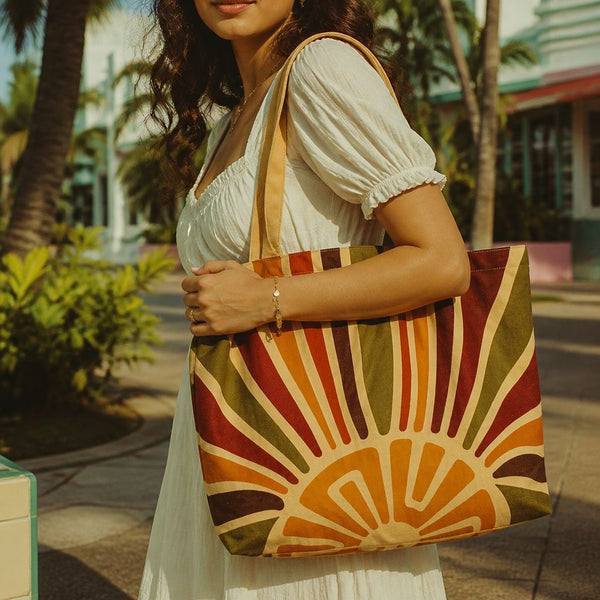
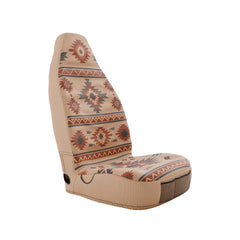
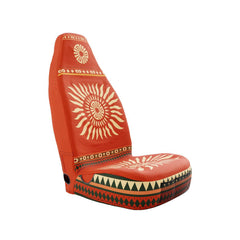
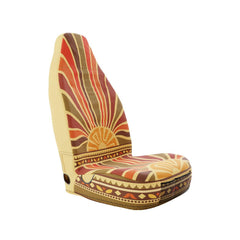
The range has twelve designs, from the stepped diamonds of Taos and the medallion of Kasbah to the sunbursts of Halo and Horizon. Check the collection for what's in stock right now.
To go deeper on how jacquard weaving actually works, our jacquard fabric explainer covers the mechanics. And if you're drawn to the geometric side of this same textile family more than the stripe, our kilim rugs guide is a related flatweave tradition worth reading. See the current patterns in the full serape blankets collection.


