

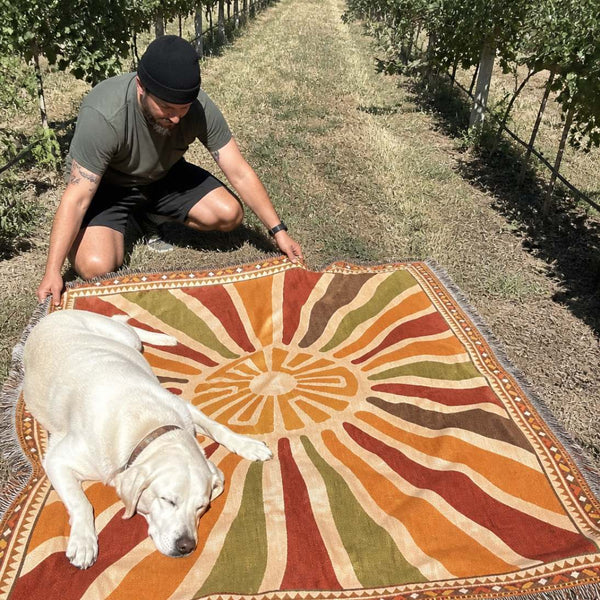
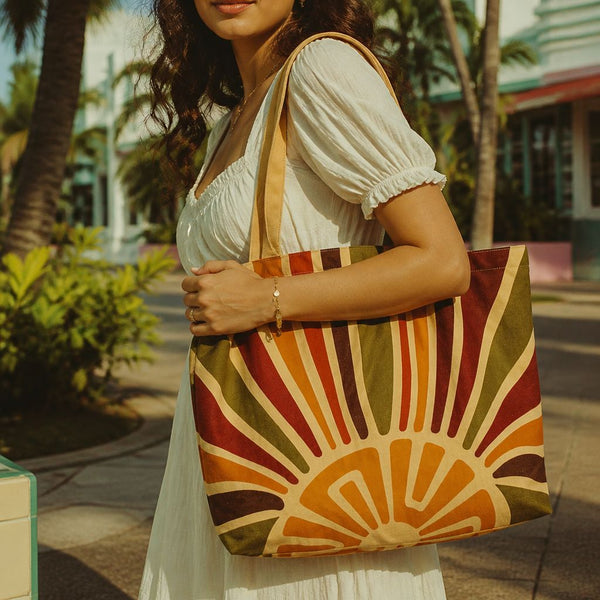











If you've searched mexican blankets, you've probably landed on two very different things: a thin $12 souvenir from a border-town gift shop, and a $150 hand-loomed heirloom from a weaving cooperative in Oaxaca. Solara's mexican blankets sit in a specific lane between those two — machine-loomed jacquard throws that borrow the stripe-and-diamond language of the tradition without pretending to be the handwoven original.
What "Mexican Blanket" Actually Covers
The search term is a catch-all. A serape is the poncho-shaped striped textile people once wore over the shoulders. A falsa is thinner, originally a saddle blanket. A Saltillo pulls in a diamond medallion at the center. Most shoppers don't need to know the difference between those three — they need a blanket that reads as that pattern family and holds up to actual use. That's what this collection is built for.
How the Pattern Gets Made
Ours are jacquard woven, not printed. A jacquard loom lifts individual warp threads to build the pattern directly into the structure of the fabric, row by row, instead of stamping color onto a plain weave afterward. You can run a fingernail along a stripe edge and feel a slight ridge where the weave changes — that's the give-away that it's structural, not surface-level. Printed patterns crack and fade unevenly with washing; a woven stripe just wears down evenly across the whole piece.
The Two Patterns We Stock
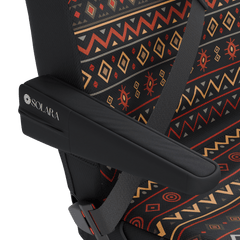
Taos leans into a warm, multicolor stripe sequence — rust, mustard, cream, worked in tight bands. Kasbah pulls the palette cooler and adds a stepped medallion in the field instead of running stripe to stripe. Neither is trying to replicate a specific regional weaving style exactly; they're a jacquard interpretation of the look, priced and produced for everyday use rather than as a collector's textile.
Styling It Without It Reading as a Costume
The fastest way to make this pattern feel intentional instead of themed is to keep everything else in the room quiet. One striped throw against solid furniture and plain walls reads as a considered accent. Two or three "Mexican-adjacent" pieces stacked in the same room starts to read as a bit. Pick one strong textile moment and let the rest of the space stay simple.
Where It Actually Gets Used
- Draped over the back of a couch or an armchair as a color anchor in an otherwise neutral room
- Folded at the foot of a bed as a layering piece, not the main bedspread
- Thrown in the trunk for a tailgate or a park picnic where you don't want to babysit something precious
- Pinned flat on a dorm or apartment wall when you want the pattern without the floor space it'd need as a rug
Keeping the Pattern Sharp Wash After Wash
Wash cold on a gentle cycle and skip the dryer's high heat — tumble low or hang it to dry instead. Jacquard weaves are dense, so a full high-heat dry cycle takes longer to fully dry through the middle than the surface looks, and repeated high heat is what eventually loosens the weave tension at the stripe borders. Wash it alone or with similar colors for the first cycle or two until you've confirmed how much dye settles.
The Trade-off We Won't Talk You Out Of
If what you actually want is a hand-loomed wool serape made by a weaving family in Teotitlán del Valle, buy that instead. It'll cost more, take longer to arrive, and be a completely different object — one where the labor and the material are the point. Ours is a machine-loomed, washable, mass-produced version of the aesthetic. That's not a knock on it; it's just a different product solving a different problem, and we'd rather say that plainly than let you find out after checkout.
Common Questions
Is this an authentic handwoven Mexican textile?
No. It's machine jacquard woven, made to reference the pattern family, not to replicate a specific artisan piece.
Can I wash it in a regular machine?
Yes, it's machine-washable. Cold water and a gentle cycle keep the stripe edges sharp longest.
Will the colors run into each other?
The pattern is woven, not printed, so there's no surface dye layer to bleed the way a cheap printed throw would in a hot wash. We still recommend washing it on its own the first time, the way you would with any new colored textile.
For the geometric side of this same palette family, our aztec rugs guide breaks down the diamond and stepped patterns. And if you want the mechanics of how jacquard weaving actually works, our jacquard fabric explainer covers it start to finish. When you're ready to see the patterns in person, the full mexican blankets collection is where Taos and Kasbah both live.


