





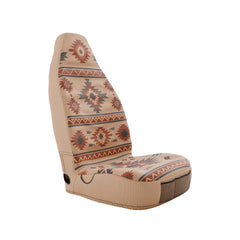
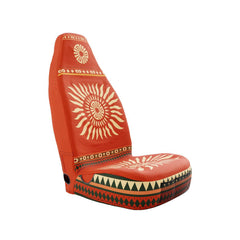

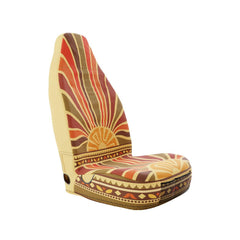







Quality fabric seat covers let the heat from heated seats through, with at most a slightly slower warm-up. Faux leather and thick foam-backed covers insulate more and slow the warm-up noticeably. Below: how heated seats actually work, which cover materials pass heat best, and what to look for if your car has heated or ventilated seats.
How heated seats work
Heated seats are simple. A heating element (resistance wire, similar to a toaster) is sewn into the seat foam beneath the upholstery. When activated, current flows through the wire, generating heat. The heat conducts through the foam and upholstery to your skin.
Most heated seats reach about 38–43°C at the surface, ramping up over 1–3 minutes. High and low settings vary the current flow.
The cover sits on top of the upholstery. Heat must pass through the cover to reach your skin. Different cover materials transmit heat differently.
Which cover materials block heat (avoid these)
Thick foam-backed covers.
Some "comfort" covers have a thick foam padding. The foam insulates, so heat takes noticeably longer to reach you and feels weaker.
Heavy faux leather (PU/PVC).
Thick coatings slow heat transfer. Combined with the way faux leather softens and cracks in heat, these covers are a poor match for heated seats.
Thick canvas / heavy-duty workwear fabric.
Heat gets through more slowly than through thinner fabric.
Sheepskin / wool covers.
Wool is an insulator, so sheepskin covers hold back a lot of the heat.
If you rely on heated seats during your commute, avoid these materials.
Which materials pass heat through (look for these)
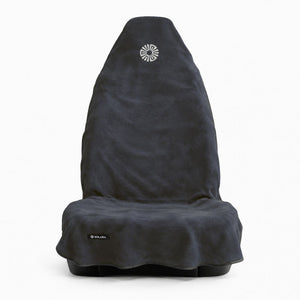
Coated fabric (Solara's covers).
Heat passes through; at most you'll notice a slightly slower warm-up.
Thin polyester (cheap covers).
Heat passes through easily, but the cover wears out long before the heated seat does.
Thin microfiber.
Similar to mid-weight fabric: good heat transmission.
Thin leather (genuine, not faux).
Transmits heat well. Genuine leather has different aging characteristics than faux.
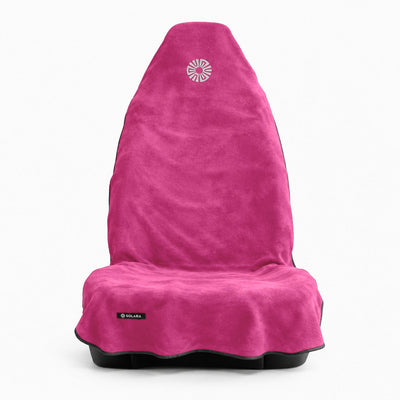
Solara's covers specifically.
Heat passes through the stretch fabric, so heated seats keep working on every setting; at most you'll notice a slightly slower warm-up.
What to expect on each setting
How a Solara cover changes the heated-seat experience:
| Setting | No cover | With a Solara cover | What you notice |
|---|---|---|---|
| Low | Gentle warmth | Gentle warmth | Little to no difference |
| Medium | Warm | Warm | Little to no difference |
| High | Hot | Hot, a little slower to build | A slightly slower warm-up |
In practice, most people don't feel a difference once the seat is up to temperature.
Ventilated seats: different considerations
Ventilated (cooled) seats are different from heated. They blow air UP through the seat fabric. Cover material affects airflow more than heat.
Cover material airflow impact:
- Coated fabric (Solara): noticeably less airflow, because a waterproof coating doesn't let much air through
- Faux leather: little to no airflow (PVC blocks air entirely)
- Thick canvas: much less airflow
- Perforated custom-fit covers: minimal airflow loss
For cars with active ventilation that matters to you (Lexus LS, Mercedes S-Class, BMW 7 Series, top Tesla trims), perforated custom-fit covers are better than universal-fit fabric.
For cars where ventilation is "nice to have" but not critical (most cars with optional ventilation), Solara's covers are still a reasonable trade: you give up much of the cooling airflow in exchange for protection, and the cover comes off easily for the hottest weeks.
What to look for if your car has both heated AND ventilated seats
Many modern cars have heated AND ventilated seats:
- Tesla Model S Plaid
- Mercedes S-Class
- BMW 7 Series
- Cadillac CT5/CT6
- Many Lexus LS/LX models
For these:
Option 1: Choose heat over ventilation.
Solara covers work well with heated seats; with ventilation, expect noticeably less airflow.
Option 2: Choose ventilation over heat.
Perforated custom-fit covers work better for ventilation but cost 4-5x more.
Option 3: Skip covers on ventilated cars.
If ventilation is a primary feature you bought the car for, accepting some seat wear is the trade-off.
For most owners, Option 1 (Solara covers) is the right answer. Heated seats are used more in everyday cold weather; ventilated seats are used occasionally in extreme heat. Optimizing for the more-frequent use makes sense.
FAQ
How quickly will my heated seat warm up with a Solara cover?
About as quickly as without a cover; at most you'll notice a slightly slower warm-up.
Will the cover prevent the heat from reaching me at all?
No. Heat passes through the stretch fabric, so the seat still warms you.
What about heated rear seats?
Same logic: heat passes through Solara's back seat cover too.
Will my heated steering wheel be affected?
Steering wheel covers (separate product) can affect heated steering wheel function. Seat covers don't touch the steering wheel.
What if my car has a heated AND massaging seat (Mercedes S-Class)?
Heat transmits through the cover. Pneumatic massage works through the cover (pressure transmits). Mechanical kneading-type massage may be slightly damped but remains functional.
Does the cover affect the heated seat's max temperature?
Not in any way you'd notice once the seat is up to temperature.
Will the cover trap heat and overheat me?
No. Heat comes from the seat and passes through to you; the cover adds no heat of its own, and once you turn the heater off it cools down normally.
What if my car has occupancy detection in the heated seat?
Occupancy is detected by weight sensors under the cushion, not by heat sensors. Covers add minimal weight and don't affect detection.
Verdict
For cars with heated seats, fabric covers like Solara's let the heat through, with at most a slightly slower warm-up. This is the right answer for almost all heated-seat owners.
Avoid: thick foam-backed covers, heavy faux leather, sheepskin, wool, all reduce heat significantly.
For cars with active ventilation that matters (luxury sedans), consider perforated custom-fit covers OR accept some airflow reduction with universal-fit fabric.
For most owners, the cover doesn't change the heated-seat experience. You'll forget you have a cover the first time you turn on the heat in winter.


