

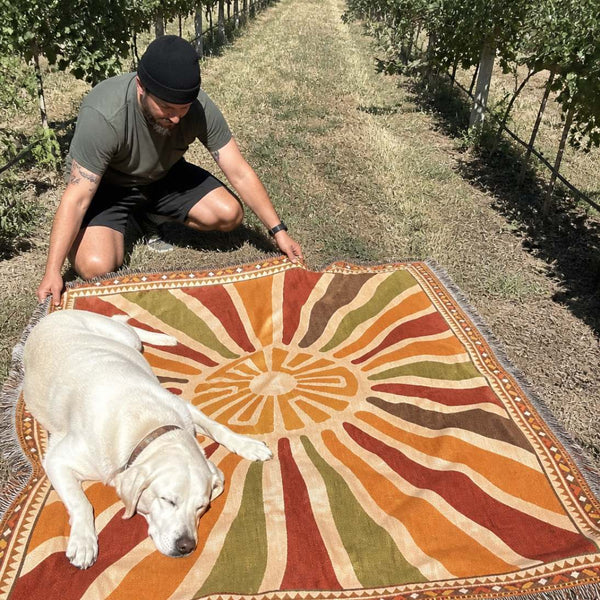
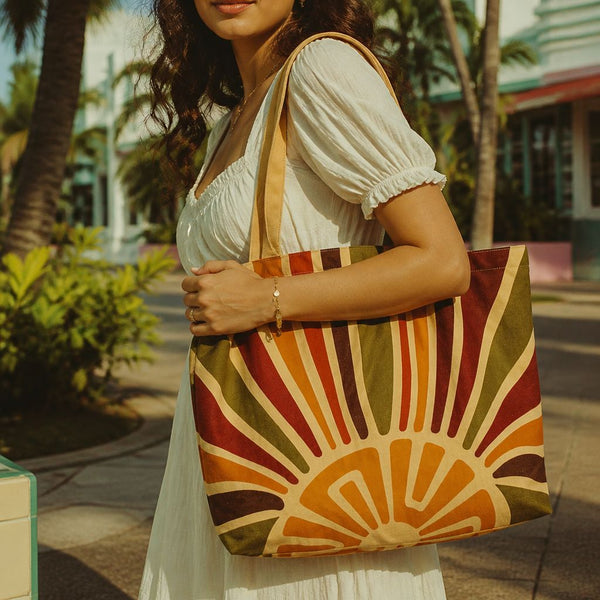











A serape is, historically, a garment before it's a home textile — a long woven cloth worn over the shoulders like a poncho, tracing back to weaving towns in central Mexico like Saltillo. Solara's serape blankets take that stripe-heavy pattern language and build it into a jacquard throw sized for a couch or a car trunk instead of a shoulder.
Where the Stripe Pattern Actually Comes From
The classic Saltillo serape developed out of a mix of Indigenous weaving techniques and Spanish colonial textile influence, originally dyed with natural pigments and woven on a backstrap or treadle loom by hand. The signature look — tight horizontal stripes in contrasting colors, sometimes building to a diamond medallion at the center — took generations of weavers to standardize into what most people picture today when they hear "serape." It was worn, not draped over furniture, which is a detail most retail listings skip entirely.
Hand-Loomed Versus Jacquard: What Actually Changes
A hand-loomed serape can take a weaver days to finish a single piece, with the stripe width and color sequence set by hand, thread by thread. A jacquard loom automates that same principle — lifting individual warp threads by machine instead of by hand — so the pattern still gets built into the structure of the fabric rather than printed on top of it, just at production speed instead of artisan speed. You can tell it's woven, not printed, by running a thumb along a color transition: there's a slight texture change where the weave shifts, not a flat printed edge.
What This Collection Is and Isn't
Ours is a cotton-blend jacquard throw in the stripe tradition, machine-washable and priced for everyday use. It isn't hand-loomed wool, and we're not going to describe it that way. If the weaving heritage itself is what you're after — supporting a specific cooperative, owning something a named artisan made by hand — that's a real and different purchase, usually from a source in Saltillo or Oaxaca directly, and it's worth seeking out on its own terms rather than assuming a mass-market throw is a substitute for it.
Getting the Look Right at Home
- Fold it in thirds lengthwise across the back of a couch so the full stripe run shows, rather than balling it into a corner
- Layer it at the foot of a bed over a solid duvet instead of using it as the main bedding — the stripe reads as an accent, not a background
- Keep it in the car for tailgates and impromptu park stops where a woven layer beats sitting on bare grass or a truck bed liner
Care That Keeps the Stripes Sharp
Wash cold, separately for the first cycle or two until you've confirmed the colors are settled, and dry on low heat or air dry. High heat is what eventually softens the weave tension at each stripe border, which is what makes older printed throws look blurry at the seams over time — a woven stripe holds its edge much longer if you keep the heat down.
Common Questions
Is a serape the same thing as a poncho?
Related but not identical — a poncho typically has a head opening cut into it to be worn as a garment. Ours is a flat throw, styled after the pattern, not a wearable poncho.
Does it feel like scratchy wool?
No. It's a woven cotton-blend, so it's softer and machine-washable in a way traditional wool serapes generally aren't.
What colors does it come in?
Check the current product listing for the exact palette in stock — we rotate designs and don't want to promise a specific color combination here that might not be current.
To go deeper on how jacquard weaving actually works, our jacquard fabric explainer covers the mechanics. And if you're drawn to the geometric side of this same textile family more than the stripe, our kilim rugs guide is a related flatweave tradition worth reading. See the current patterns in the full serape blankets collection.


