












Every beach has the same archaeology: families perched on bath towels slowly sinking into the sand, sitting on maybe forty percent of the fabric they brought. Towels are drying equipment drafted into territory duty, and they're bad at it — terry loops grip sand like velcro and hold water like grudges. The beach blanket is the actual tool, and choosing one comes down to three physical facts.
Fact one: weave decides the sand situation
Sand interacts with fabric two ways — embedding in loops and pile (towels, fleece) or resting on flat weaves until shaken off. A flat jacquard weave sheds sand with one flick; that single property is most of what separates a good beach blanket from an itchy regret. Parachute-nylon “sand-free” mats take this further but pay elsewhere — they're crinkly, sweaty and fly away; the full comparison is in the sand-free deep dive.
Fact two: size is seating capacity
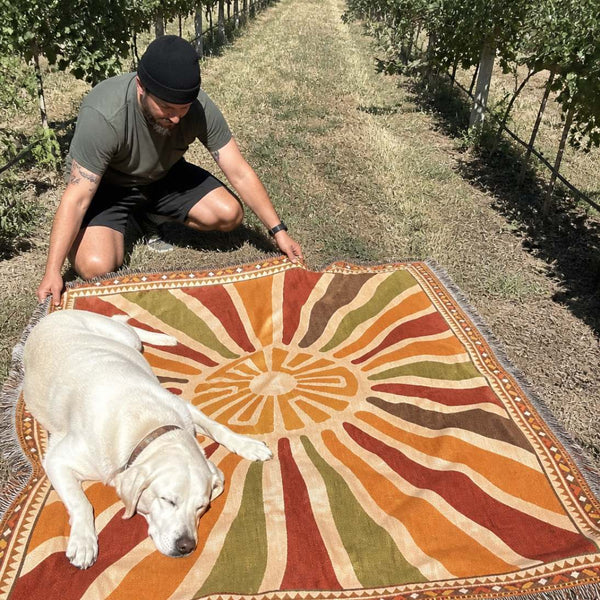
A bath towel seats one; a 130×180 cm blanket seats three adults or one family sprawl with the cooler on a corner. Bigger sounds better until you carry it — at about a kilo, our jacquard rugs hit the carry-versus-territory sweet spot: rolls into a beach tote, claims real estate like furniture.
Fact three: wind is undefeated (but manageable)
The corners-in-the-air ballet is solved by weight at the corners — the cooler, shoes, the bag — and by fabric with actual mass. A fringed woven blanket sits; nylon sails. Choose accordingly.
The multi-life argument
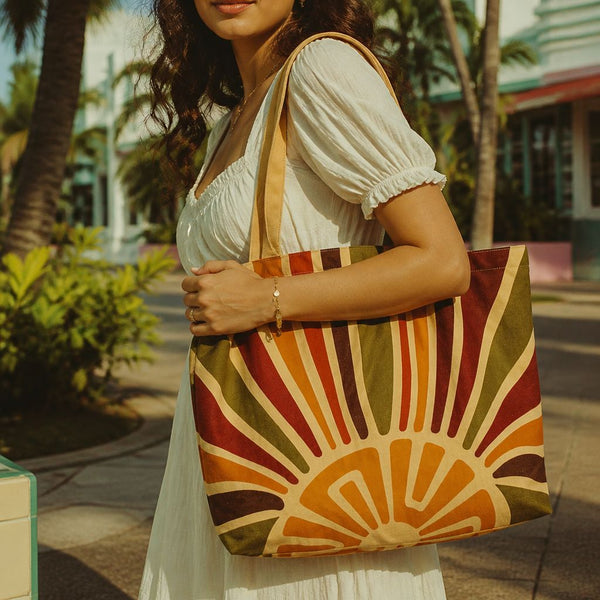
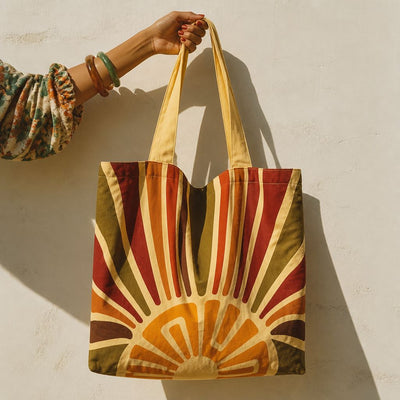
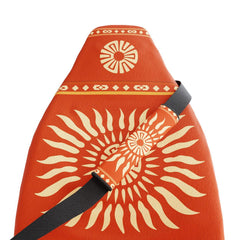
The best beach blanket isn't beach-only — it's the picnic base, the car blanket and the winter sofa throw, machine washing between lives (how). Patterns like Halo's sunburst and Solstice's sun-and-moon were drawn for exactly this light. Towels dry people. Blankets host afternoons.


