


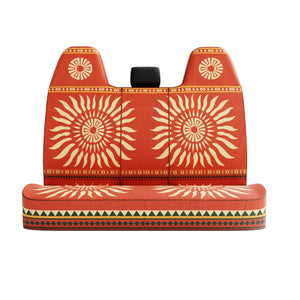


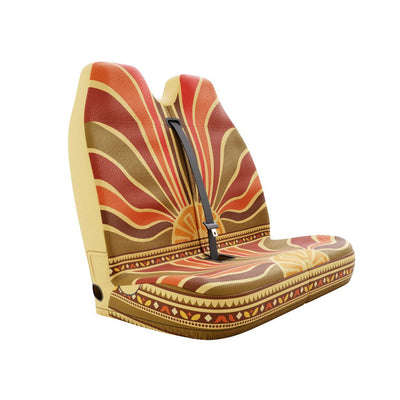

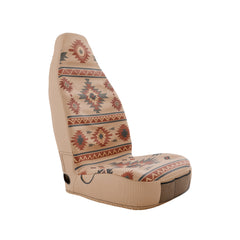
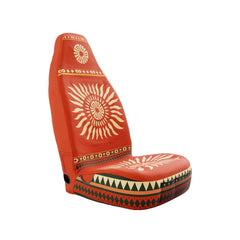

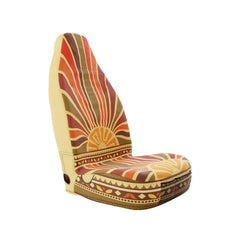



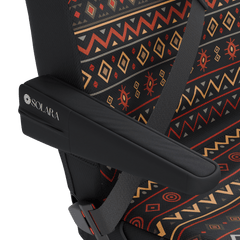


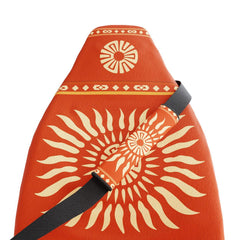



Universal stretch covers like Solara's work on the Tesla Model 3 and Model Y, including the 2026 Highland refresh. An airbag-friendly side seam leaves the side airbags free, and if you're unsure about your seats, the size guide is the place to check. In this guide, we walk through Tesla-specific wear patterns, the best aftermarket covers for the Model 3 and Y, and the install quirks unique to Tesla's design.
Why Tesla owners are switching to aftermarket seat covers
Tesla's stock vegan-leather seats look great in year one. By year three, owners notice three problems:
1. Driver bolster wear. The driver's outer bolster collapses or tears from entry/exit friction. By 60,000 miles, this is visible on most Model 3s and Ys.
2. White seat staining. The popular white interior option stains permanently from blue jeans, food, and sunscreen. Tesla service can't always remove these.
3. Heated seat plastic feel. As the vegan leather ages, it loses suppleness and starts feeling more like plastic than leather.
Aftermarket seat covers solve all three: they protect the bolster, hide stains, and add fabric warmth back to the cabin.
Vegan leather vs. cloth - Tesla's OEM seats and their wear issues
Every modern Tesla (2018 onwards) uses vegan leather (a synthetic material Tesla calls "Tesla Vegan Leather" - chemically a textured polyurethane). It's designed to resist wear better than traditional leather, but the bolster failure mode is well-documented across Model 3, Model Y, Model S, and Model X.
The wear pattern:
- Driver outer bolster: friction wear from sliding in and out. First visible at 30–50k miles.
- Driver seat bottom front edge: cracking from where the back of your thigh contacts. Visible at 60–90k miles.
- Steering wheel side of driver seat: small tears from buckle scratches.
Tesla owners who want to protect resale value often install aftermarket covers within the first year. It's much cheaper than reupholstery later (~$1,800 per seat at a Tesla service center for vegan leather replacement).
The common Tesla seat wear pattern
We've reviewed 50+ Model 3 and Model Y trade-ins, and the wear pattern is consistent:
|
Wear type |
Avg first appearance |
Severity by 100k miles |
|
Driver bolster scuffing |
35,000 mi |
Visible to severe |
|
The driver's bottom edge is cracking |
75,000 mi |
Mild to visible |
|
White seat staining |
Permanent at first stain |
Permanent |
|
Heated seat warmth fade |
N/A: heater works fine |
N/A |
The good news: this is exactly the wear pattern that universal-fit covers prevent. The cover takes the friction and stains; the underlying seat stays factory-fresh underneath.
Best aftermarket seat covers for Model 3 (Highland refresh and pre-Highland)
The 2026 Highland refresh changed the Model 3's interior dashboard but the seat geometry is essentially identical to the 2017–2023 Model 3. Universal covers fit both.
Top pick: Solara's Stone Grey or Sand on the front seats, plus a back seat cover in one of six prints if the back seat needs it. Stone Grey's cool gray pairs especially well with Tesla's white interior; Sand works on the all-black interior. Luna is the move if you want a pattern.
Why Solara for Tesla specifically:
- One-piece headrest design accommodated by a stretch fit
- Engineered seam allows side airbag deployment
- Mid-weight fabric doesn't trap heat from heated seats
- Pattern aesthetic fits Tesla's design language (clean, intentional, slightly minimalist)
Best aftermarket seat covers for Model Y
The Model Y has a slightly larger seat than the Model 3 - wider individual front seats to match the SUV body. Universal covers fit both, but the Model Y's deeper bolsters benefit from a longer install (push the cover deeper into the bolster crease).
Top pick: Solara's Luna or Indigo on the front seats, with an Indigo back seat cover for the back seat. The Model Y's family-vehicle use case favors more pattern (it hides stains better), and Luna or Indigo works against both white and black interiors.
For Model Y 7-seat configurations (the optional third row), the front and back seat covers still apply; Solara doesn't make a cover for the third row itself.
Will aftermarket covers affect the heated/ventilated seats?
Heated seats: Yes. Heat passes through the stretch fabric, so heated seats keep working; at most you'll notice a slightly slower warm-up.
Ventilated seats (Model S Plaid only - not Model 3 or Y): Vented seats blow air up through the seat fabric. A thick cover reduces airflow by 20–30%. If you have a Model S Plaid and value ventilation, custom-fit perforated covers are better than universal-fit.
Lumbar adjustment: Tesla's pneumatic lumbar works through covers without modification. The cover stretches as the lumbar inflates.
Installation notes - Tesla's one-piece headrest
The most distinctive Tesla install quirk is the one-piece headrest on the Model 3 and Model Y. Unlike most cars, the headrest doesn't pop off - it's permanently molded into the seatback.
This sounds like a problem for installing covers but isn't. Universal stretch-fit covers slide over the headrest from above. The fabric stretches enough to clear the headrest's width.
Install sequence for Tesla front seats:
- Hold cover by its top corners
- Stretch downward over the headrest (the cover has a pre-cut headrest slot; align it before pulling down)
- Pull cover down evenly over the seatback
- Tuck the bottom into the seat crease, push deep into the bolster contours
- Smooth the fabric flat; the stretch fit holds it in place without straps or clips
-
Adjust until taut and flat
Total time: 60–90 seconds per seat. The Model Y's deeper bolsters might take an extra 15 seconds to push the fabric in.
Tesla owner FAQ
Will the cover affect Tesla's seat occupancy sensor?
No. The sensor is a weight-based detector under the seat cushion. Covers add minimal weight and don't trigger false readings.
What about the seatbelt tensioner / pretensioner?
Tesla's pretensioners are at the B-pillar (rear-facing, mounted in the door pillar), not in the seat. Covers don't affect them.
Will the camera-based driver attention monitoring still work?
Yes. The cabin camera (above the rearview mirror) tracks driver eyes and head, not seat color or pattern.
Can I still use the seat heater memory feature?
Yes. Heater memory is in software; physical covers don't affect it.
Will the cover fit the new 2026 Highland Model 3?
In most cases, yes. Solara's universal covers are made for standard front seats like the Model 3's, across all interior trims (white, black, Sport interior). If you're unsure, check the size guide before ordering.
Are these covers eco-friendly enough for Tesla owners?
Solara's covers are a printed fabric with a waterproof coating, not leather. They're machine washable on a cold cycle, so keeping them clean doesn't call for special cleaning products.
Pattern recommendations for Tesla interiors
White interior (Model 3 / Model Y):
- Stone Grey (cool gray) - looks intentional, slightly muted
- Indigo (dark blue) - bold contrast that protects from stains
- Sand (warm beige) - softens the cabin
Black interior:
- Sand (warm beige) - adds warmth
- Luna (boho geometric) - adds visual interest
- Clay (deep earth brown): sophisticated contrast
Sport interior (carbon-fiber accents on performance trims):
- Stone Grey - keeps the techy minimalism
- Indigo - masculine bold contrast
Verdict - our pick
For a Tesla Model 3 or Model Y refresh, our pick is Solara's Stone Grey on the front seats. The cool gray works on every Tesla interior, the fabric handles family life, and installation takes under two minutes per seat.
If you have a white interior and want to protect against denim stains, Stone Grey is non-negotiable. It's the single best decision a white-interior Tesla owner can make in their first year of ownership.


